
Fabricated Rebar vs. Field-Cut Rebar: Which Actually Saves North Carolina Contractors More Time?
Fabricated rebar, cut and bent to spec before it reaches the site, almost always saves more time overall than field-cutting, because it removes the layout guesswork and lets crews move straight to placement. Field-cutting still has its place for small, last-minute adjustments on a job already underway, but as the primary approach on anything mid-size or larger, it tends to slow a crew down rather than speed them up.
Every contractor bidding a commercial pour eventually faces this decision, usually somewhere in the estimating process before the first delivery date is even set. Order fabricated rebar from a shop and build the schedule around a delivery window, or keep a crew on site cutting and bending to the plans as the job progresses. Both are legitimate approaches. They just aren't equally fast, and the gap tends to be bigger than most people expect until they've run both ways on similar jobs.
The decision usually gets made once, early, and then lived with for the rest of the job. That's part of what makes it worth slowing down on during bidding rather than defaulting to whatever the last project used. A framework that worked fine on a small slab job doesn't automatically scale to a multi-level structure with a tight placement schedule, and the two approaches put very different demands on crew time once the job is actually underway.
What Actually Happens During Fabrication vs. Field-Cutting?
M&N's Fabricated Rebar team handles the full sequence in-house: bid and estimating, field placement submittals, fabrication to spec, and delivery, backed by more than 150 years of combined team experience across the group. Rebar shows up on site already cut, bent, and tagged to the plan, ready for placement. Field-cutting, by comparison, puts that same layout and bending work on the crew's schedule, using rebar tie guns and cutting tools on site, which works fine on small jobs but competes directly with every other task that crew is also responsible for that day.
Where Does Field-Cutting Still Make Sense?
It's not that field-cutting is wrong. Small jobs, quick repairs, or last-minute plan changes after fabricated rebar has already been delivered are all reasonable spots to cut in the field rather than waiting on a new fabrication run. The distinction that matters is scale. Cutting fifteen pieces on site to patch a plan change is a non-issue. Cutting and bending the bulk of a mid-rise commercial job's rebar on site, piece by piece, is a different math problem entirely.
There's also a labor availability angle worth factoring in. Field-cutting only works as a time-saver when the crew has slack to absorb it, and on a lot of jobs right now, that slack doesn't exist. Skilled labor is tight across the Triangle, and pulling crew members off placement or finishing work to cut and bend rebar means something else on the schedule slows down to cover it. Fabricated rebar sidesteps that tradeoff entirely, since the cutting and bending happens off site, on a schedule that doesn't compete with the rest of the crew's day.
How Does Delivery Timing Compare Between the Two?
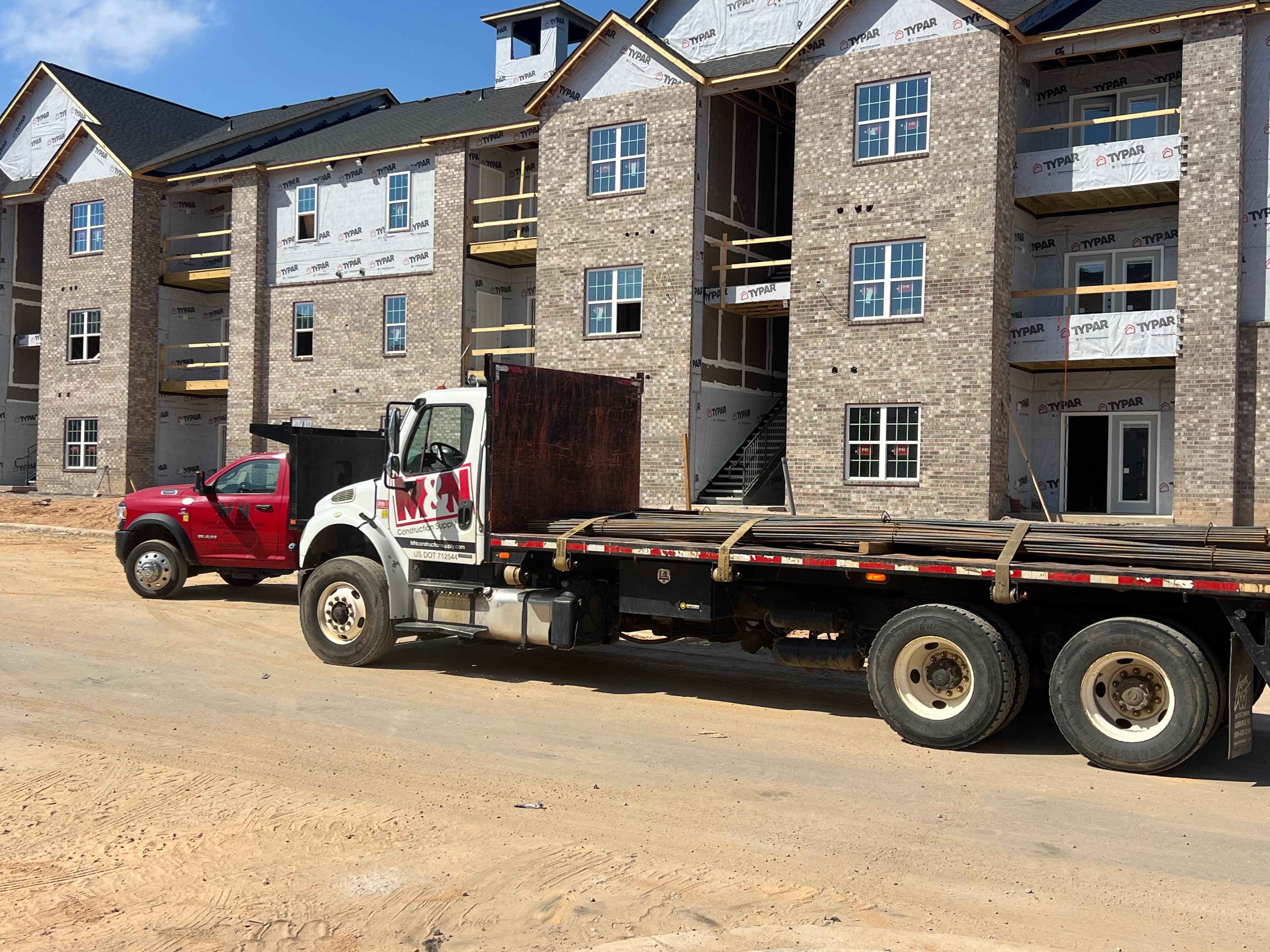
This is where the two approaches diverge the most. M&N fabricates thousands of tons of rebar annually and delivers with its own in-house drivers rather than outsourcing to third-party logistics, which means delivery timing is something the same team managing the fabrication also controls end to end. The Raleigh location operates as M&N's dedicated rebar hub, giving jobs across the Triangle a shorter path from fabrication to delivery than relying on a supplier shipping in from out of state. Field-cutting has no equivalent delivery step to plan around since the material shows up as raw stock, but that also means there's no fabrication lead time working in the background while other parts of the job move forward. A quote request through any of M&N's three North Carolina locations, including Wilmington, routes to the same rebar team either way.
What Does It Cost to Switch from Field-Cutting to Fabricated Rebar?
Pricing isn't posted online since it depends on tonnage, complexity, and project timeline, so M&N quotes each job individually through its estimating team. For contractors used to pricing rebar as raw material plus labor hours, the fabricated route folds cutting and bending labor into the fabrication cost instead, which is worth comparing against the field-cut math rather than assuming one is automatically cheaper. A conversation with the contact team is the fastest way to get real numbers for a specific job.
Is There a Quality Difference Between the Two Approaches?
Consistency is usually the bigger factor than raw quality. A shop fabrication run follows the same spec on every piece, checked against the submittal before it ever leaves the facility, which cuts down on the placement errors that show up when several different crew members are cutting and bending by hand over the course of a long pour. Field-cutting isn't inherently lower quality when it's done by an experienced crew, but it depends on that crew's consistency shift to shift, and on a big job with rotating labor, that consistency is harder to guarantee than a single fabrication run checked once against the plan.
The Raleigh-Cary-Durham-Apex corridor has been one of the busiest commercial construction markets in the state, and that growth puts real pressure on scheduling. A shop that can turn fabrication around quickly and deliver with its own fleet, rather than depending on a third-party carrier, matters more in a market where a two-day delivery slip can push an entire pour schedule. Neither Sunbelt Rentals nor United Rentals, the two largest equipment rental competitors active in the Raleigh market, offer rebar fabrication at all, which leaves that piece of the job to specialty suppliers. North Carolina's commercial building codes also require documented rebar placement submittals on most projects of any size, which is exactly the kind of paperwork a full-service fabrication team handles as part of the process rather than leaving it to the field crew to track down.
Frequently Asked Questions
Is fabricated rebar more expensive than field-cut rebar in North Carolina? It depends on the job. Fabrication folds cutting and bending labor into the material cost, while field-cutting shifts that labor onto the crew's schedule, so the real comparison is total project cost and time, not just the price per ton.
How long does rebar fabrication take through M&N's Raleigh location? Turnaround depends on tonnage and project complexity, since Raleigh operates as M&N's dedicated rebar hub with in-house estimating and fabrication. A specific project timeline comes from the estimating team once they have the plans.
Can M&N deliver fabricated rebar outside Raleigh, like Cary or Durham? Yes. M&N's in-house delivery fleet serves the broader Triangle area including Cary, Durham, Apex, Garner, and Wake Forest, not just Raleigh proper.
Does M&N handle both estimating and delivery in-house, or do they subcontract parts of it? Both stay in-house. The bid and estimating process, fabrication, and delivery are all handled by M&N's own team rather than outsourced to third parties.
Fabricated rebar or field-cut, the right call usually comes down to project size and how tight the schedule already is. Talk to M&N's Raleigh rebar team at (919) 779-7711 and get a real estimate before the next bid goes out.